Coordinates, Time, and the Sky by John Thorstensen A very nice 36 page pdf file. You will probably want to print this out.
Image formation by a lens A lens forms an *image* of an objects by bending light rays from the object. If we put a piece of photographic film (or nowadays an electronic imaging detector) where the image is we have a camera or telescope.
Focal length of lens The distance from the central plane of the lens to the place where the image forms (for a very distant object) is called the focal length. The two most important properties of a lens are its diameter and its focal length.
Visual telescope. When you think of "telescope", you probably think of a tube that you look through. A simple visual telescope uses a lens or mirror to form an image, which is then visually inspected with a small magnifying glass, or eyepiece. However, most astronomical telescopes are used as giant cameras. There is no need for an eyepiece, we put our detector directly in the image plane.
Spherical and chromatic aberration in lenses.. (Above line): A lens which has a curve that is part of a sphere will not bring distant light to a good focus due to spherical aberration. A lens with a special non-spherical (an aspherical lens) can bring distant light rays to a sharp focus.
(Below line): Different color light is bent slightly differently when passing through a lens. This defect is called chromatic aberration. This means that there is no common focus for the light, and images will look fuzzy. By combining two lens, made of different types of glass, we can reduce the effects of chromatic aberration.
In a reflecting (mirror) optical system, the light does not pass thorugh the mirror, and there is no chromatic aberration. This is a big advantage of reflecting over refracting telescopes.
Spherical aberration in mirrors. Just as in a lens, a spherical - curved mirror exhibits spherical aberration (but not chromatic aberration). By making the curve on the mirror parabolic in shape, spherical aberration is eliminated.
Refracting and reflecting telescopes A refracting telescope uses a lens as its primary light collecting optical element. A reflecting telescope uses a mirror as its primary light collecting optical element.
Cassegrain telescope There are many different optical configurations for telescopes. This one uses 2 mirror, the primary (largere) and the secondary (smaller). The focal plane is behind the primary mirror. The primary has a big hole in the middle.
Schmidt and Schmidt-Cassegrain telescopes The Schmidt camera is a telescope that has a mirror AND a refracting (transmissive) corrector plate. This combination refractor/ reflector is often called a catadioptric system.
Some common astronomical telescope variants
Yerkes 40 inch refractor. This telescope was completed in 1897. It remains the largest successful refracting telescope (lens as primary light gathering element) ever made (a larger lens made in France in 1900 never worked). The telescope is located at Williams Bay, Wisconsin, which is not a very good observing site by todays standards! Note how long and thin the telescope is- the focal length is about 19 meters, and the lens is 1 meter in diameter, so its an f/19 telescope.
Kitt Peak National Observatory, Arizona. This national (governement funded) observatory was founded in the late 1950s as a response to Sputnik. Access to telescopes here is open by competition to all qualified astronomers in the US. The observatory is located at 2200 meter elevation, about 80 km from Tucson. Because of growth of Tucson and Phoenix, the site is no longer completely dark, but its still a decent site. The largest telescope is a 4 meter (on left side of image). The odd triangular structure on the right is a telescope designed to study the Sun. Larger U. S. National Observatory telescopes are now located in Hawaii and Chile. I have spent over 300 nights of my life on this mountaintop.
4 meter telescope DrBill near Cass cage 4 DrBill with spectrograph The 4 meter RC telescope at Kitt Peak. This telescope was built in the 1970s. The black cylindrical structure is the "flip cage", which can be flipped end over end. One end of the tube has a prime focus, the other a secondary mirror to send the light to a standard RC focus behind the primary mirror.
Palomar 200 inch (5 meter). This telescope was built over 50 years ago, and remained the world's largest telescope for decades. It is located northeast of San Diego, California.
WIYN telescope mirror support. This is the back end of the WIYN (Wisconsin- Indiana- Yale- NOAO) 3.5 meter telescope on Kitt Peak. The primary mirror is thin, so that it can reach thermal equilibrium with the surrounding air quickly. This helps the seeing, or image sharpness. However, the mirror is so thin that it could not hold the proper shape by itself. Therefore, an active mirror control system pushes on the back of the mirror to bend it into the proper shape. The blue cylinders are part of the pistons that push on the mirror,.
Mauna Kea, Hawaii Keck telescope Mauna Kea The 4200 meter elevation summit of Mauna Kea, on the Big Island of Hawaii, is one of the worlds best observing sites. Note the complete absence of green plants- that is a good thing in an observing site, as it suggests lack of rainfall (and hopefully lack of clouds!). The silver structure to my right is the Japanese 8.4 meter Subaru telescope. The two white domes house the twin Keck 10 meter telescopes.
It does snow in Hawaii The white stuff in front of domes is snow, which is not uncommon at 4200 meter altitude in Hawaii. The white stuff behind the silver dome are clouds below the summit. The dark mass behind the silver dome is Maui, about 130 km (80 miles) from Mauna Kea, across the Alenuihaha Channel (yes, this will be on the test- just kidding).
Keck Headquarters building. Most astronomers who use the Keck tekescopes actually control the telescope from this building, which is about 30 km from the telescopes, at a much lower altitude! The telescopes can just be seen as white dots at the apex of Mauna Kea, which dominates the horizon in this image.
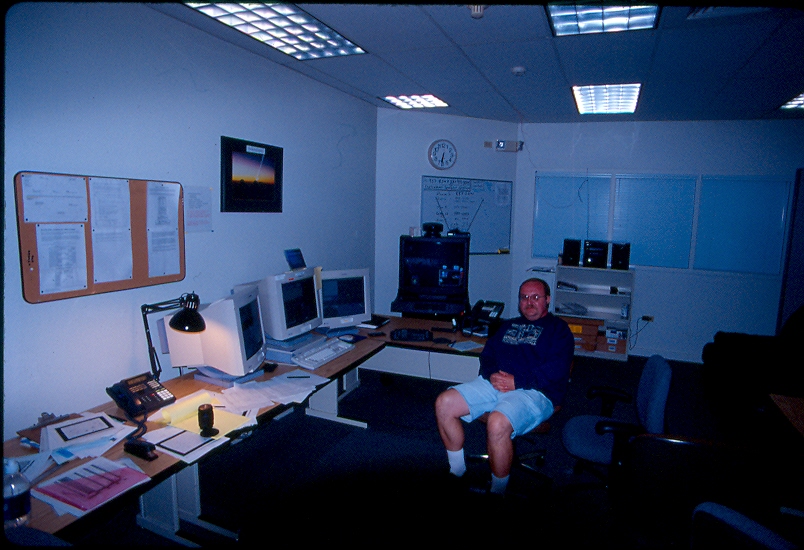
Tired astronomer in Keck control room. Here I am after a LONG nights work! Not that I am complaining. It was clear!
Side view of Keck telescope Looking into dome of Keck The Keck telescopes don't look as impressive as the Palomar 5 meter, even though each Keck has a mirror about twice diameter of the Palomar telescope. The Kecks are "short and fat", meaning they have a much faster (lower f/ ratio) primary than does the Palomar telescope.
Back end of Keck telescope. The primary mirror of the Keck telescopes are made up of 36 hexagons, each about 2 meters across. At each corner of each hexagon, pistons push and pull the individual mirrors to keep the overall mirror in the proper shape. An engineering marvel! (And it works!)
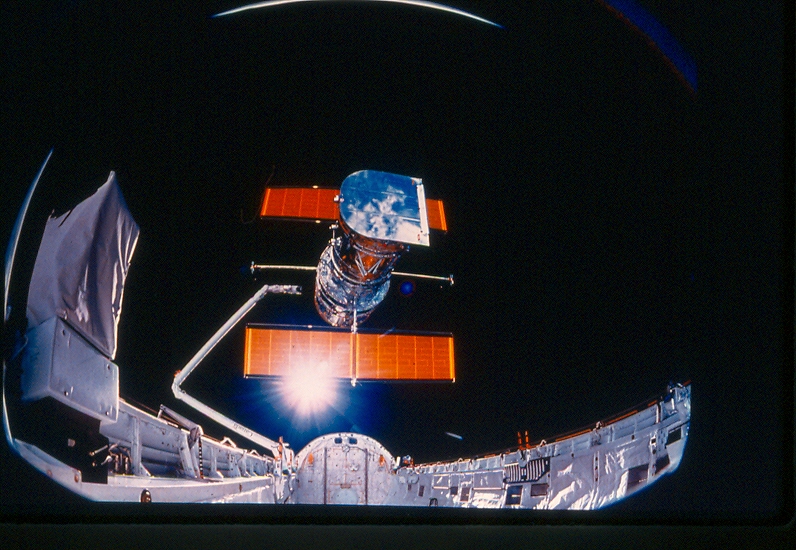
Deployment of Hubble Space Telescope from Shuttle bay. Here, in 1990, the Hubble Space Telescope (HST) is being moved out of the Space Shuttle cargo bay to be left in space.
HST cartoon. As soon as HST returned its first images, it was clear (or maybe "unclear" would be a better word) that something was very wrong. Turned out the primary mirror had been made to the wrong shape, so there was spherical aberration which resulted in greatly diminished angular resolving power. Hubble became the butt of many jokes- this is just one example. It was a major PR disaster for NASA.
Fixing HST. The main mirror on the HST (2.4 meters in diameter) was made to the wrong shape. This caused images to be about as sharp as images obtained from the ground, rather than much sharper as expected. In 1993, corrective optics were installed by astronauts, and the telescope has worked pretty well since then. Here an astronaut works in space to fix the Hubble's optical problems by inserting a module with "corrective lenses".
Optical light resolution vs. year. This is a schematic diagram showing the best resolution (ability to resolve two objects close in sky into two separate objects). The resolution is shown in arcsec, so smaller (towards top) is better. Before the telescope, resolution was limited by the human eye to 50 - 80 arcsec. The telescope, introduced around 1600AD, allowed a jump in resolving power. Although larger telescope should give better resolution, the Earth's atmosphere limits groundbased observations to about 1 arcsec resolution, so that even though vast improvements were made in telescopes from 1600 to 2000, the angular resolution didn't improve much. The HST (at least after 1993 "fix") is of course not affected by the blurring effects of the atmosphere, so its resolution is limited only by the telescope optics. The resolution of HST is about 0.1 arcsec.
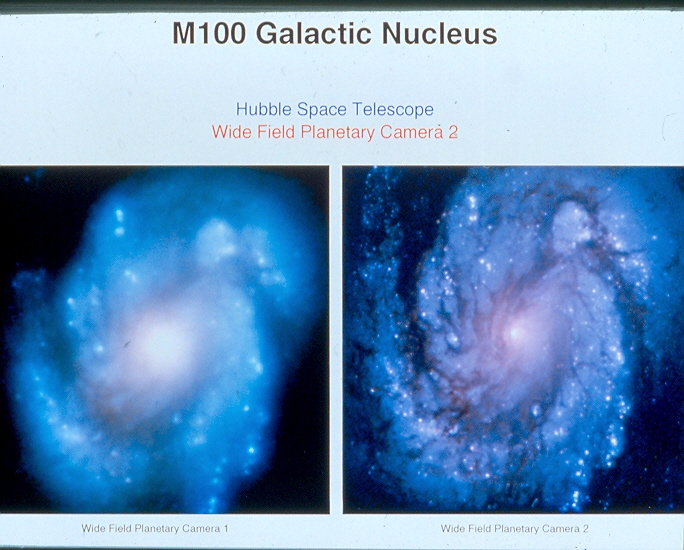
Improved resolution with HST fix. This shows two images, obtained with HST, of the same galaxy. The righthand image was obtained after the 1993 optical fix. Note the great improvement in detail seen, as the resolution was much improved by the fix.
Kuiper Airborne Observatory. Astronomers are always trying to get high - I mean they try to get their telescopes above as much of the Earth's distorting atmosphere as possible. Space is the best place to put telescopes, but that is extremely expensive and time-consuming. To get above much of the atmosphere, telescopes have been placed on airplanes, small rockets, and balloons. Here is a dedicated aircraft observatory, called the Kuiper Airborne Observatory, on a C-141A jet transport aircraft. The black square is an opening through which a 0.9 meter telescope views the sky. This observatory is being replaced by a much larger telescope (2.5 meter diameter) on a 747 aircraft, called (for now) SOFIA- Stratospheric Observatory for Infrared Astronomy.
Infrared Astronomy Satellite (IRAS) telescope. Long before Hubble, many small telescopes were placed into Earth orbit. These were all designed to observe wavelengths that don't penetrate the Earth's atmopshere- x-rays, ultraviolet, many infrared wavelengths. Here is a very small telescope called IRAS that observed the infrared sky from Earth orbit in the mid 1980s. Although it was a very small telescope compared to telescopes on the ground, it made many important discoveries, as it observed wavelengths that simply cannot be studied from the ground. The main mirror was 0.6 meter in diamter (24 inches) smaller than the telescopes of some amateur astronomers!
There are many, many more small telescopes that have been placed in orbit over the past 40 years. This is just one example.
U.S. at night This is an image of the light pollution, caused by man-made lights, across the US.
Dark sky OK panhandle / NE NM The only "darkest sky" in Oklahoma, where there is essentially no problem with light pollution, is the very northwest corner of the Oklahoma panhandle. This is a "negative" image, with areas with darker sky showing as lighter shades of gray.
Large Synoptic Survey Telescope (LSST) The proposed LSST will have a mirror roughly equal in size (8.4 meters) to the mirrors in the largest telescopes now operating, but will operate quite differently from other large telescopes. Current large telescopes can only look at a very small part of the sky at once. The LSST will be able to look at a much larger piece of sky. The LSST will take very detailed pictures covering the ENTIRE SKY every few nights. Current big telescopes would require years or decades to take pictures covering the entire sky. The LSST will allow astronomers to do many types of projects, including searching for asteroids that might someday hit the Earth. If the $300 million can be found to build the telescope, it could be operating around 2014. The data will be made public immediately. This will allow astronomers from anywhere to do their own research using the data. Although there are current astronomical data archives that allow public access to vast amounts of data, such as the HST archives, this telescope should mark a new way to obtain and deal with optical images from large groundbased telescopes. There is, of course, a website: www.lsst.org.
Model of detector for LSST camera The camera for the LSST will use a large number of individual CCDs (electronic "film") arranged in a big array. This is an "actual size" model of the array, although the current design uses somewhat fewer, but larger, individual CCDs than this mockup. Each little square is a CCD bigger and more sensitive than the best digital camera chip. All together, the camera will have about 3.2 Billion pixels, or individual "dots" in the image. In terms of digital camera advertising, this is a "3200 megapixel" camera!! The camera will produce a staggering amount of digital data each clear nite, and the guys from Google are planning to help deal with the tremendous data flow. Each clear *nite*, the camera is expected to generate 25 TeraBytes of digital images!!
CCD versus photographic plate. The vast improvement in quantum efficiency between photographic plates and CCDs is illustrated here. These are images of teh same exact patch of sky. The lower exposure, taken with a CCD and a much shorter exposure than the upper image, taken with a photographic plate, goes MUCH deeper (detects fainter objects) even though it was taken in only 5 minutes, as opposed to 90 minutes for the top image!
WOW!